AuthorityIdentifies the issuing power. The authority can be "pretended" when the name or the portrait of X is on the coin but he/she was not the issuing power. It can also be "uncertain" when there is no mention of X on the coin but he/she was the issuing power according to the historical sources:
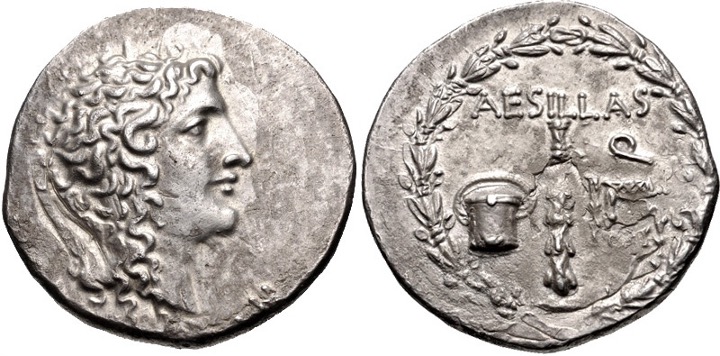
FromIdentifies the initial date in a range assigned in a numismatic context. 95 BCE toIdentifies the final date in a range assigned in a numismatic context.. 70 BCE
Hellenistic 323-30 BCperiodTime period of the numismatic object.
Physical description
MetalThe physical material (usually metal) from which an object is made.: Silver
DenominationTerm indicating the value of a numismatic object. Examples: tetradrachm, chalkous, denarius.: tetradrachm
AuthorityIdentifies the authority in whose name (explicitly or implicitly) a numismatic object was issued.ᵖ:
Chronology
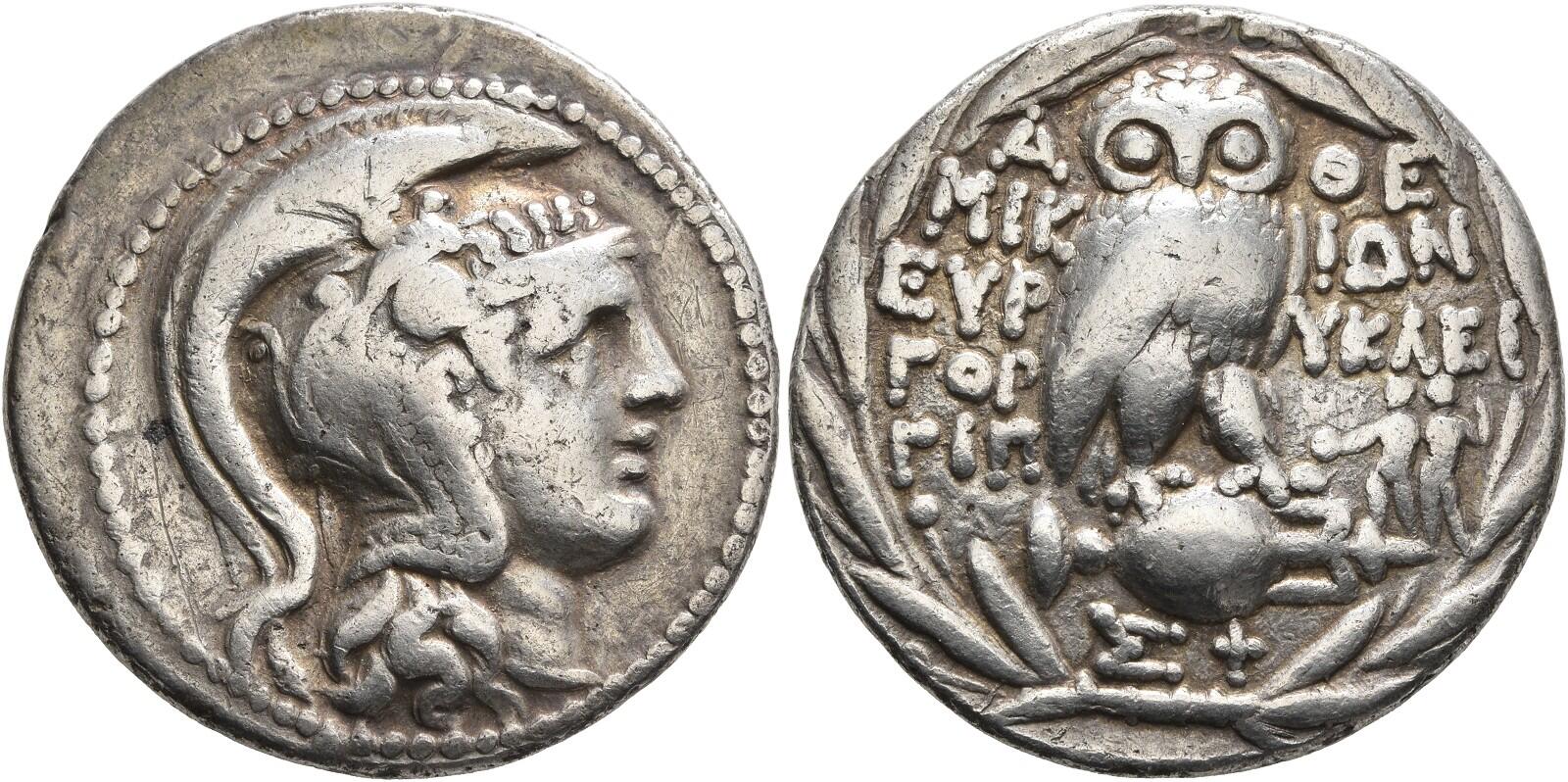
FromIdentifies the initial date in a range assigned in a numismatic context. 166 BCE toIdentifies the final date in a range assigned in a numismatic context.. 70 BCE
Hellenistic 323-30 BCperiodTime period of the numismatic object.
Physical description
DenominationTerm indicating the value of a numismatic object. Examples: tetradrachm, chalkous, denarius.ᵖ:
^Bauslaugh, Robert A. (2000), Silver coinage with the types of Aesillas the Quaestor, Numismatic Studies 22, New York.
^Hoover, Oliver D. (2016), Handbook of coins of Macedon and its neighbors. 3. Part I: Macedon, Illyria, and Epeiros, sixth to first centuries BC, Lancaster, 437 p.
^Callataÿ, François de (2021), “On pattern and purpose of overstrikes of late Hellenistic tetradrachms in Thrace Macedonia”, in Ulrike Peter and Bernhard Weisser (eds.), Thrace. Local coinage and regional identity, Berlin Studies of the Ancient World 77, Berlin, Topoi, p. 263-289.
^Thompson, Margaret (1961), The new style silver coinage of Athens, Numismatic Studies 10, New York, 2 vol.


 periodTime period of the numismatic object.