AuthorityIdentifies the issuing power. The authority can be "pretended" when the name or the portrait of X is on the coin but he/she was not the issuing power. It can also be "uncertain" when there is no mention of X on the coin but he/she was the issuing power according to the historical sources:
Chronology
FromIdentifies the initial date in a range assigned in a numismatic context. 31 BCE toIdentifies the final date in a range assigned in a numismatic context.. 60 CE
Roman from 30 BCperiodTime period of the numismatic object.
Physical description
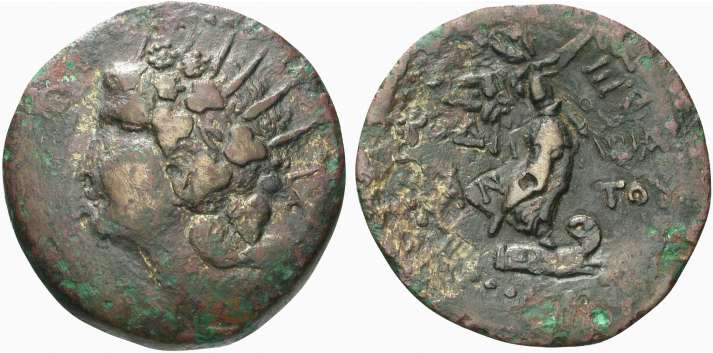
MetalThe physical material (usually metal) from which an object is made.: Bronze
WeightWeight of the numismatic object (in grams).in grams: 24.9424.94 g <br />24,940 mg <br />
^Head, V. Barclay (1897), A Catalogue of the Greek coins in the British Museum. vol. XV : Caria, Cos, Rhodes, etc., London, The Trustees, p. 325, pl. XLV.
^Amandry, Michel - Burnett, Andrew - Ripolles, Pere Pau (1998), Roman provincial coinage. I. From the death of Caesar to the death of Vitellius (44 BC-AC 69), London-Paris, 2 vol., xvii + 812 p., 195 pl.
^Ashton, Richard and Westermark, Ulla (1994), Sylloge Nummorum Graecorum, Finland, The Erkki Keckman Collection in the Skopbank, Helsinki, Part 1: Karia,

 periodTime period of the numismatic object.