AuthorityIdentifies the issuing power. The authority can be "pretended" when the name or the portrait of X is on the coin but he/she was not the issuing power. It can also be "uncertain" when there is no mention of X on the coin but he/she was the issuing power according to the historical sources:
Chronology
FromIdentifies the initial date in a range assigned in a numismatic context. 176 BCE toIdentifies the final date in a range assigned in a numismatic context.. 142 BCE
Hellenistic 323-30 BCperiodTime period of the numismatic object.
Physical description
MetalThe physical material (usually metal) from which an object is made.: Silver
WeightWeight of the numismatic object (in grams).in grams: 16.8216.82 g <br />16,820 mg <br />
DenominationTerm indicating the value of a numismatic object. Examples: tetradrachm, chalkous, denarius.: tetradrachm
"Portraits of Prusias II (ca. 182-149) and Nikomedes II (149-ca. 127) [...] corresponds both in position and outline to the trace preserved on the Athenian reverse" (nb: not really visible; the shape of the nose on the obverse excludes most of the royal Hellenistic portraits)
References
^Thompson, Margaret (1961), The new style silver coinage of Athens, Numismatic Studies 10, New York, 2 vol.
^Bauslaugh, Robert A. (1987), "Two unpublished overstrikes: new style Athens and Aesillas the Quaestor," American Numismatic Society. Museum notes 32, p. 11-21
^Hoover, Oliver D. (2014), Handbook of Greek Coinage Series 4. Northern and Central Greece : Achaia Phthiotis, Ainis, Magnesia, Malis, Oita, Perrhaibia, Thessaly, Akarnania, Aitolia, Lokris, Phokis, Boiotia, Euboia, Attica, Megaris and Corinthia, sixth to first centuries BC, Lancaster, lxxi, 563 p.
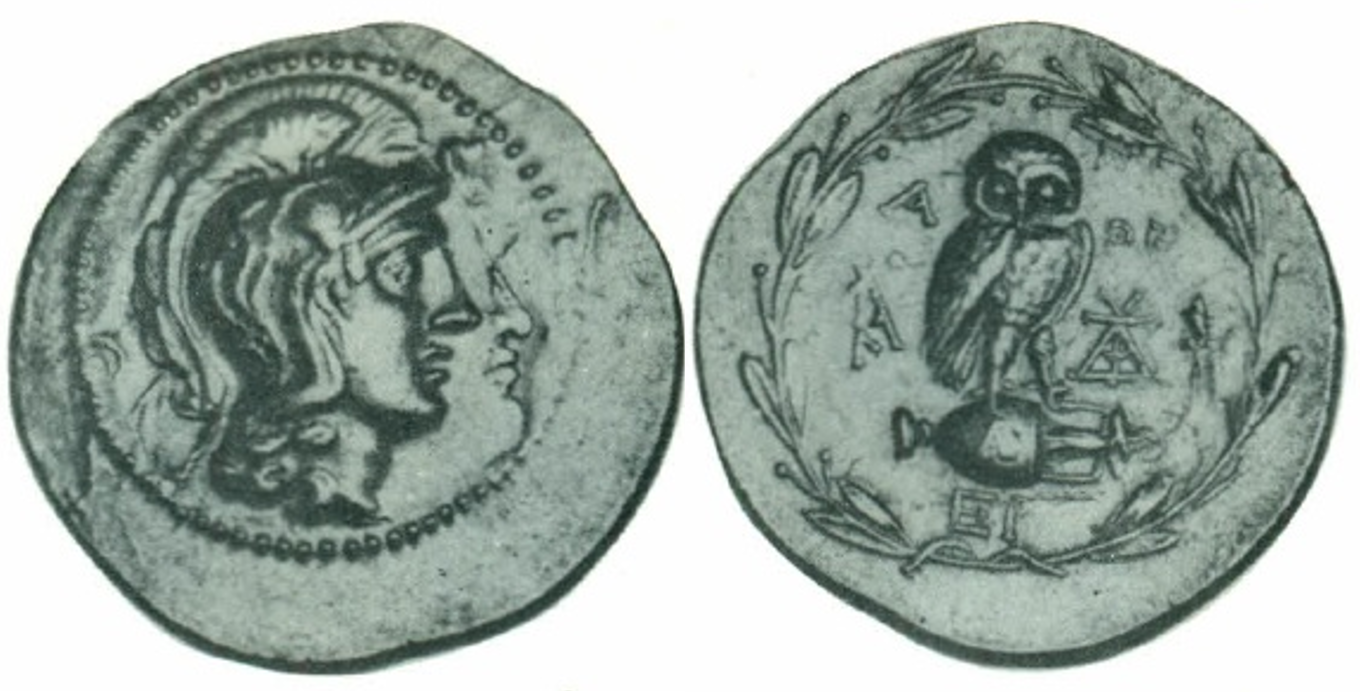

 periodTime period of the numismatic object.