15824 - Amphipolis (Alexander the Great) (tetradrachm Heracles/Zeus) over uncertain type (CNG, MBS 78, May 2008, 336): Difference between revisions
From SILVER
No edit summary |
No edit summary |
||
| Line 9: | Line 9: | ||
|Ancient region=Macedon | |Ancient region=Macedon | ||
|Authority=Alexander III the Great (Argead king, 336-323 BC) | |Authority=Alexander III the Great (Argead king, 336-323 BC) | ||
|Date from= | |Date from=336 BCE | ||
|Date to= | |Date to=323 BCE | ||
|Period=Classical | |Period=Classical | ||
|Metal=Silver | |Metal=Silver | ||
Revision as of 15:51, 15 May 2023
336 BCE - 323 BCE | ΑΛΕΞΑΝΔΡΟΥ
Images
Overstriking coin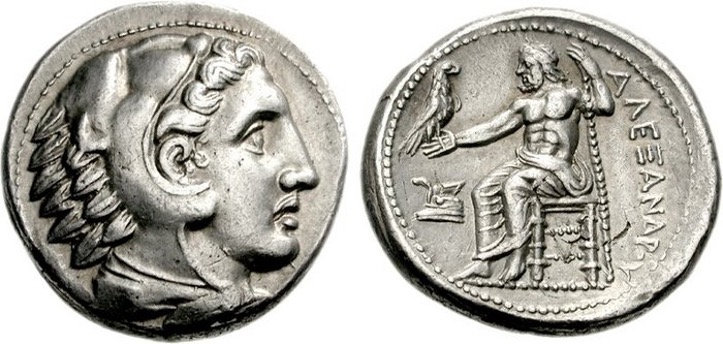

Amphipolis 2314.jpg
Location/history
| Museum collectionMuseum collection: | Collection C.P.A. Ex Münzen und Medaillen Deutschland 10, 22 March 2002, lot 183. | |
Overstriking coin
Description
| ObverseInscription or printing placed on the obverse.: | Head of Herakles right, wearing lion skin | ReverseInscription or printing placed on the reverse.: | ΑΛΕΞΑΝΔΡΟΥ (Greek) Zeus Aëtophoros seated left, in left field, prow left |
Mint and issuing power
| MintIdentifies the place of manufacture or issue of a numismatic object.: | Amphipolis | Ancient regionAncient region. | Macedon | Modern countryModern country: Greece | AuthorityIdentifies the issuing power. The authority can be "pretended" when the name or the portrait of X is on the coin but he/she was not the issuing power. It can also be "uncertain" when there is no mention of X on the coin but he/she was the issuing power according to the historical sources: | Alexander III the Great (Argead king, 336-323 BC) |
Chronology
| FromIdentifies the initial date in a range assigned in a numismatic context. 336 BCE toIdentifies the final date in a range assigned in a numismatic context.. 323 BCE | Classical 480-323 BC  periodTime period of the numismatic object. periodTime period of the numismatic object.
|
Physical description
| MetalThe physical material (usually metal) from which an object is made.: Silver
|
WeightWeight of the numismatic object (in grams). in grams: 17.2217.22 g <br />17,220 mg <br /> | DenominationTerm indicating the value of a numismatic object. Examples: tetradrachm, chalkous, denarius.: tetradrachm
|
AxisDescribes the directional relationship between the obverse and reverse of a numismatic object.: 22 mm <br />0.2 cm <br /> |
| StandardStandard.: Attic | |||
References
| Coin referenceReference of the Coin: | Coin series referenceReference to coin series study: | Price 19911Price 1991, n° 4, Troxell 19972Troxell 1997, Studies, Group A1. EF, toned | |
| Coin series web referenceCoin series web references: | |||
Overstruck type
Description
| ObverseInscription or printing placed on the obverse.: | ReverseInscription or printing placed on the reverse.: |
Mint and issuing power
| MintIdentifies the place of manufacture or issue of a numismatic object. ᵖ: | Ancient regionAncient region. ᵖ | Modern countryModern country: | AuthorityIdentifies the authority in whose name (explicitly or implicitly) a numismatic object was issued. ᵖ: |
Chronology
| FromIdentifies the initial date in a range assigned in a numismatic context. toIdentifies the final date in a range assigned in a numismatic context.. | periodTime period of the numismatic object. |
Physical description
References
| Coin type referenceReference to coin series study ᵖ: |
Additional data
| Frequency of overstrikesFrequency of overstrikes: | Level of confidenceLevel of confidence of the identification: | strong | |
| RemarksRemarks: | "Overstruck on uncertain type" | ||
References
- ^ Price, Martin Jessop (1991), The Coinage in the Name of Alexander the Great and Philip Arrhidaeus: a British Museum Catalogue, 2 vol., Zürich-London, 637 p., 637 p., clix pl.
- ^ Troxell, Hyla A. (1997), Studies in the Macedonian Coinage of Alexander the Great, Numismatic Studies 21, New York, 161 p., 31 pl.