2312 - Taras (nomos rider/Taras FB 45) over Corinthian type (Pegasus/Athena) (Stack’s & Bowers/ Ponterio, Aug. 2016, 22005): Difference between revisions
From SILVER
No edit summary |
|||
| Line 9: | Line 9: | ||
|Mint=Taras | |Mint=Taras | ||
|Ancient region=Calabria | |Ancient region=Calabria | ||
|Date from= | |Date from=349 BCE | ||
|Date to= | |Date to=340 BCE | ||
|Period=Classical | |Period=Classical | ||
|Metal=Silver | |Metal=Silver | ||
Revision as of 17:12, 18 January 2024
349 BCE - 340 BCE | TAPAΣ
Images
Overstriking coin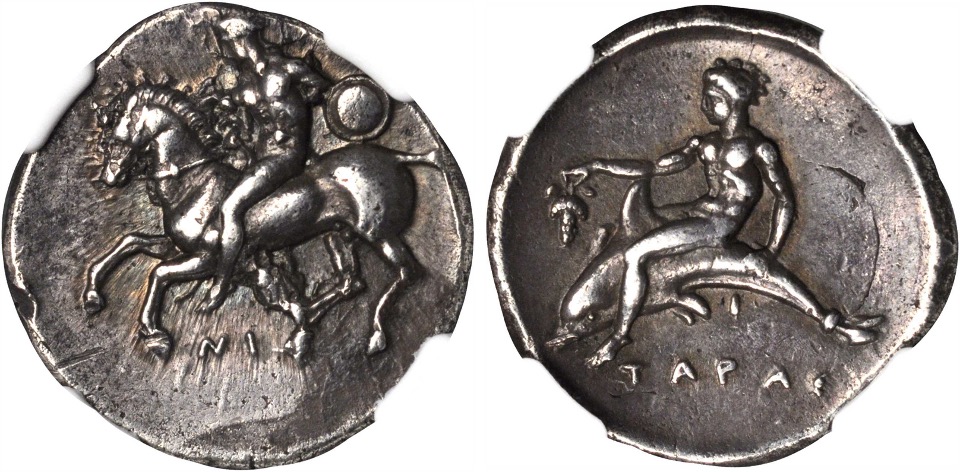

SO 1348 - Taras over uncertain mint.jpg
Overstruck variety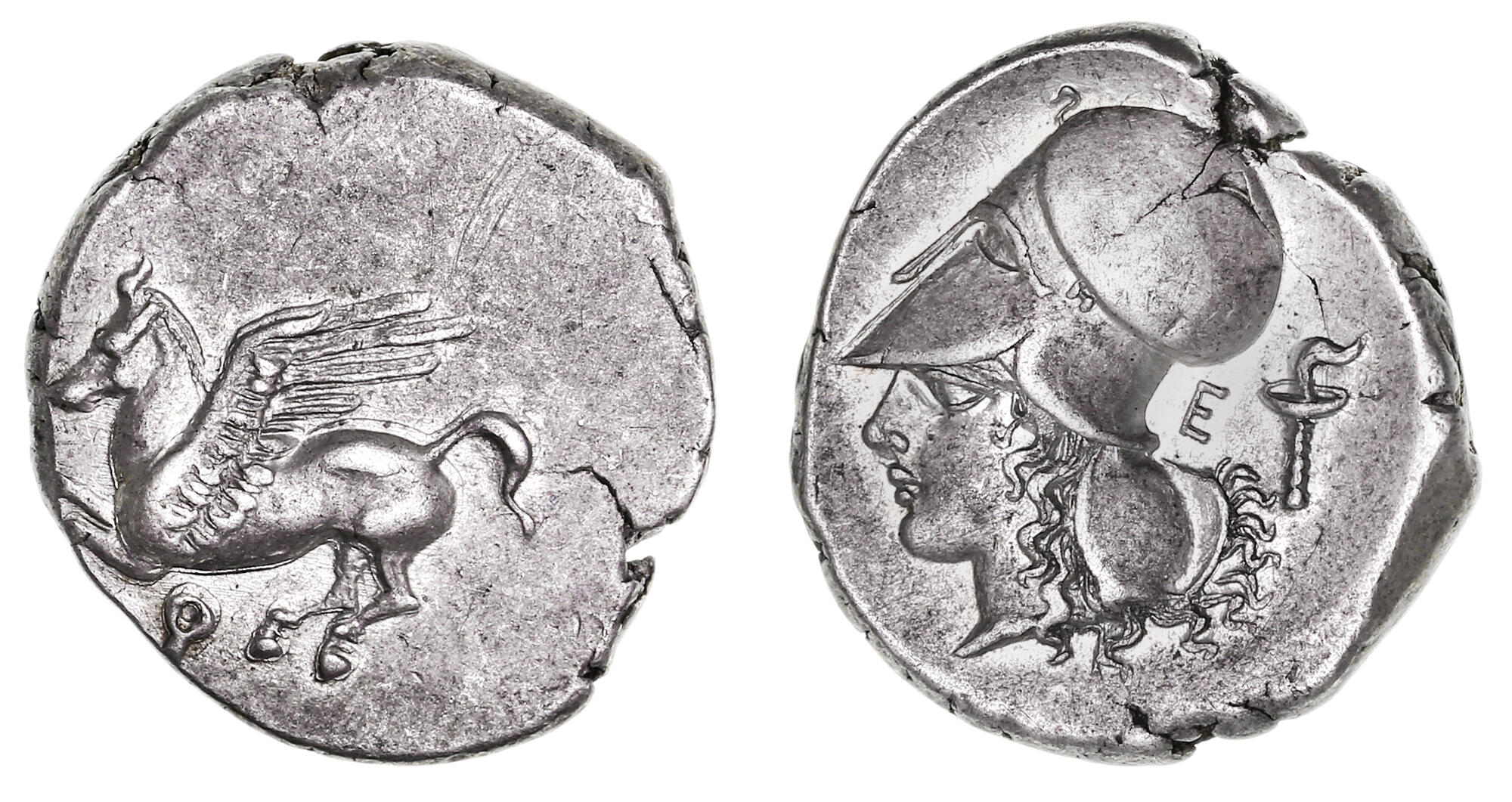

Corinth Calciati 372.jpg
Location/history
| Sale(s)Sale(s) ᵖ: | Stack’s & Bowers/ Ponterio, 10 Aug. 2016, 22005 | |
Overstriking coin
Description
| ObverseInscription or printing placed on the obverse.: | Male character seated on horse galloping to left, naked, holding reins in one hand and shield and spear in other. Below, NI. | ReverseInscription or printing placed on the reverse.: | TAPAΣ (Greek) Male character (Taras or Phalanthos), nude, seated on a dolphin to left, holding grapes bunch. Below, I. |
Mint and issuing power
| MintIdentifies the place of manufacture or issue of a numismatic object.: | Taras | Ancient regionAncient region. | Calabria | Modern countryModern country: Italy | AuthorityIdentifies the issuing power. The authority can be "pretended" when the name or the portrait of X is on the coin but he/she was not the issuing power. It can also be "uncertain" when there is no mention of X on the coin but he/she was the issuing power according to the historical sources: |
Chronology
| FromIdentifies the initial date in a range assigned in a numismatic context. 349 BCE toIdentifies the final date in a range assigned in a numismatic context.. 340 BCE | Classical 480-323 BC  periodTime period of the numismatic object. periodTime period of the numismatic object.
|
Physical description
| MetalThe physical material (usually metal) from which an object is made.: Silver
|
WeightWeight of the numismatic object (in grams). in grams: 7.857.85 g <br />7,850 mg <br /> | DenominationTerm indicating the value of a numismatic object. Examples: tetradrachm, chalkous, denarius.: nomos | |
| StandardStandard.: Achaian | |||
References
| Coin referenceReference of the Coin: | Coin series referenceReference to coin series study: | HN Italy1HN Italy, n° 884, HGC 12HGC 1, n° 782 | |
| Coin series web referenceCoin series web references: | |||
Overstruck type
Description
| ObverseInscription or printing placed on the obverse.: | Pegasus flying | ReverseInscription or printing placed on the reverse.: | Head of Athena left, wearing a Corinthian helmet ( |
Mint and issuing power
| MintIdentifies the place of manufacture or issue of a numismatic object. ᵖ: | Corinth | Ancient regionAncient region. ᵖ | Peloponnesus | Modern countryModern country: Greece | AuthorityIdentifies the authority in whose name (explicitly or implicitly) a numismatic object was issued. ᵖ: |
Chronology
| FromIdentifies the initial date in a range assigned in a numismatic context. 420 BCE toIdentifies the final date in a range assigned in a numismatic context.. 355 BCE | Classical 480-323 BC periodTime period of the numismatic object.
|
Physical description
| DenominationTerm indicating the value of a numismatic object. Examples: tetradrachm, chalkous, denarius. ᵖ: | stater
|
References
| Coin type referenceReference to coin series study ᵖ: | Calciati 19903Calciati 1990, n° 378, HGC 44HGC 4, n° 1830-1840 | ||
| Coin series web reference overstruckCoin series web references overstruck: | |||
Additional data
| Frequency of overstrikesFrequency of overstrikes: | rare and concentrated | Level of confidenceLevel of confidence of the identification: | strong |
| RemarksRemarks: | nb: over Corinthian type (here given to Corinth) | ||
References
- ^ Rutter N. Keith et alii (eds.) (2001), Historia Numorum Italy, London, xvi, 223 p., 43 pl.
- ^ Hoover, Oliver D. (2018), The Handbook of Greek Coinage Series, Volume 1. Handbook of Coins of Italy and Magna Graecia, Sixth to First Centuries BC., Lancaster-London, 2018, lxi, 527 pages, 23 cm
- ^ Calciati, Romolo (1990), Pegasi, Mortara, Edizioni I.P..
- ^ Hoover, Oliver D. (2014), Handbook of Greek Coinage Series 4. Northern and Central Greece : Achaia Phthiotis, Ainis, Magnesia, Malis, Oita, Perrhaibia, Thessaly, Akarnania, Aitolia, Lokris, Phokis, Boiotia, Euboia, Attica, Megaris and Corinthia, sixth to first centuries BC, Lancaster, lxxi, 563 p.