1755 - Metapontum (nomos ear of barley/ear of barley) over Corinthian type (Pegasus/Athena) (Oxford, AM): Difference between revisions
From SILVER
(CSV import-Overstrikes-2022-08-16) |
No edit summary |
||
| Line 1: | Line 1: | ||
{{Overstrike | {{Overstrike | ||
|Image overstriking coin=SO 1210 - Metapontum over Corinth.jpg | |||
|Image overstruck variety=SO 1210 - Metapontum over Corinth overstruck variety.jpg | |||
|Image reference overstruck variety=https://pro.coinarchives.com/a/lotviewer.php?LotID=2007360&AucID=4767&Lot=109 | |||
|Museum collection=Oxford, Ashmolean Museum | |Museum collection=Oxford, Ashmolean Museum | ||
|Obverse legend=META | |Obverse legend=META | ||
| Line 6: | Line 9: | ||
|Mint=Metapontum | |Mint=Metapontum | ||
|Ancient region=Magna Graecia (Lucania) | |Ancient region=Magna Graecia (Lucania) | ||
|Date from=549 BCE | |||
|Date to=510 BCE | |||
|Period=Archaic | |||
|Metal=Silver | |||
|Weight=7.57 | |Weight=7.57 | ||
|Denomination=Stater | |Denomination=Didrachm; Stater; Nomos | ||
|Standard=Achaian | |Standard=Achaian | ||
|Coin reference= | |Coin reference=Sutherland 1952, p. 115-116. | ||
|Coin series reference= | |Coin series reference=Rutter 2001, no. 1459, 1463, 1465, 1467, 1470, 1472, 1474, 1479, 1481-1486; Hoover 2018, no. 1027-1029 | ||
|Overstruck obverse description=Pegasus right (visible on reverse of the coin). | |Overstruck obverse description=Pegasus right (visible on reverse of the coin). | ||
|Overstruck reverse description=head of Athena right, wearing Corinthian helmet, within incuse square (visible on obverse of the coin: outlines of the incuse square, top and face-piece of the helmet, the base of the hair-queue, the neck-truncation and chin). | |Overstruck reverse description=head of Athena right, wearing Corinthian helmet, within incuse square (visible on obverse of the coin: outlines of the incuse square, top and face-piece of the helmet, the base of the hair-queue, the neck-truncation and chin). | ||
|Overstruck mint=Corinth | |Overstruck mint=Corinth | ||
|Overstruck ancient region=Peloponnesus | |Overstruck ancient region=Peloponnesus | ||
|Overstruck denomination= | |Overstruck date from=550 BCE | ||
|Coin series reference overstruck=Ravel, 2nd period, 1st class (T 94-T 130) | |Overstruck date to=500 BCE | ||
|Overstruck period=ancient period | |||
|Overstruck denomination=Didrachm; Stater; Nomos | |||
|Overstruck standard=Aeginetic | |||
|Coin series reference overstruck=Ravel 1936, 2nd period, 1st class (T 94-T 130) | |||
|Frequency of overstrikes=frequent | |||
|Level of confidence=sure | |||
}} | }} | ||
Revision as of 09:40, 17 October 2022
549 BCE - 510 BCEMETA
Images
Overstriking coin

SO 1210 - Metapontum over Corinth.jpg
Overstruck variety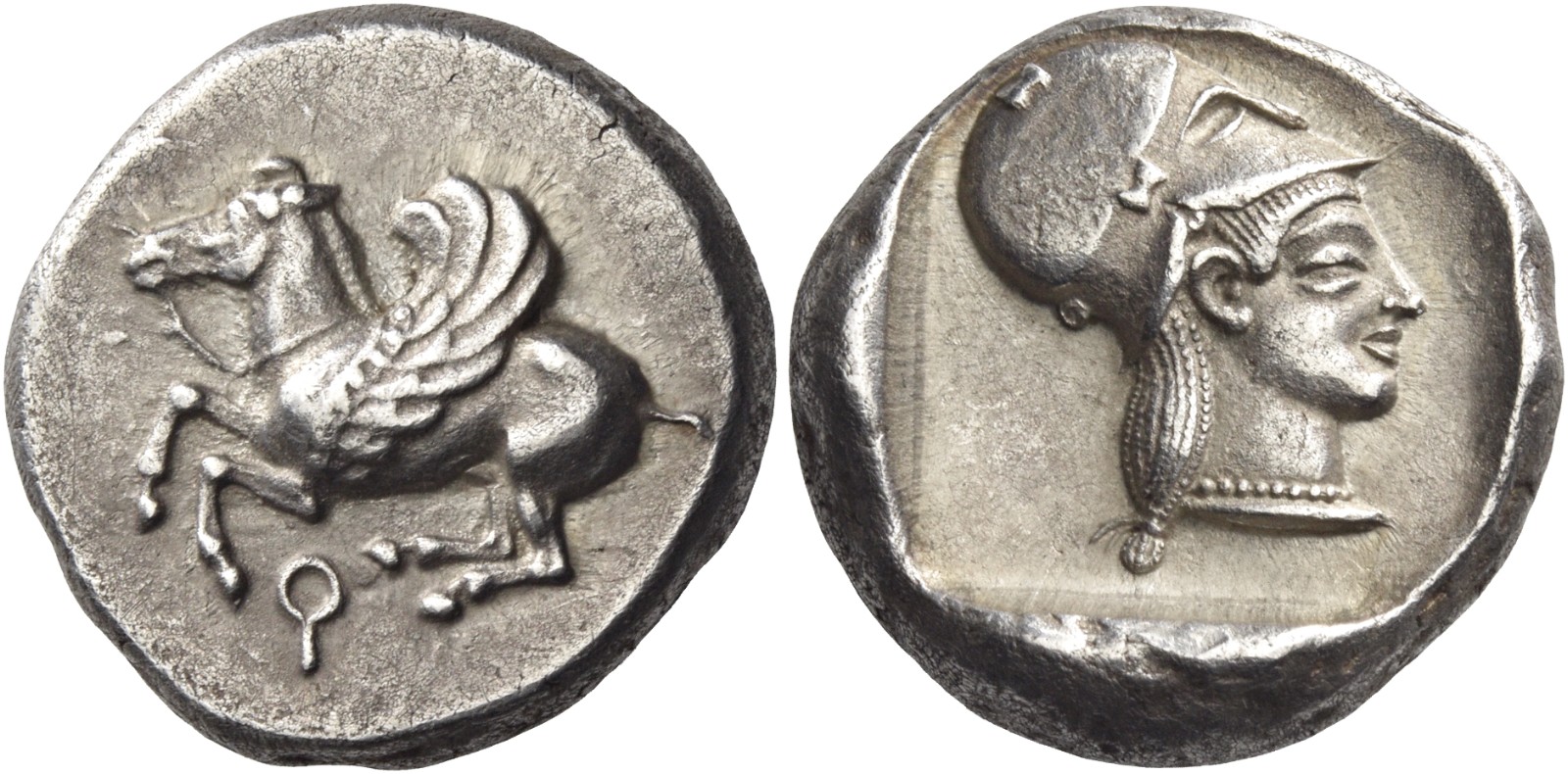

SO 1210 - Metapontum over Corinth overstruck variety.jpg [1]
Location/history
| Museum collectionMuseum collection: | Oxford, Ashmolean Museum | |
Overstriking coin
Description
| ObverseInscription or printing placed on the obverse.: | META Ear of grain. | ReverseInscription or printing placed on the reverse.: | Ear of grain (incuse). |
Mint and issuing power
| MintIdentifies the place of manufacture or issue of a numismatic object.: | Metapontum | Ancient regionAncient region. | Magna Graecia (Lucania) | Modern countryModern country: Italy | AuthorityIdentifies the issuing power. The authority can be "pretended" when the name or the portrait of X is on the coin but he/she was not the issuing power. It can also be "uncertain" when there is no mention of X on the coin but he/she was the issuing power according to the historical sources: |
Chronology
| FromIdentifies the initial date in a range assigned in a numismatic context. 549 BCE toIdentifies the final date in a range assigned in a numismatic context.. 510 BCE | Archaic until 480 BC  periodTime period of the numismatic object. periodTime period of the numismatic object.
|
Physical description
| MetalThe physical material (usually metal) from which an object is made.: Silver
|
WeightWeight of the numismatic object (in grams). in grams: 7.577.57 g <br />7,570 mg <br /> | DenominationTerm indicating the value of a numismatic object. Examples: tetradrachm, chalkous, denarius.: Didrachm, Stater, Nomos | |
| StandardStandard.: Achaian | |||
References
| Coin referenceReference of the Coin: | Sutherland 1952, p. 115-116. | Coin series referenceReference to coin series study: | Rutter 20011Rutter 2001, no. 1459, 1463, 1465, 1467, 1470, 1472, 1474, 1479, 1481-1486, Hoover 20182Hoover 2018, no. 1027-1029 |
Overstruck type
Description
| ObverseInscription or printing placed on the obverse.: | Pegasus right (visible on reverse of the coin). | ReverseInscription or printing placed on the reverse.: | head of Athena right, wearing Corinthian helmet, within incuse square (visible on obverse of the coin: outlines of the incuse square, top and face-piece of the helmet, the base of the hair-queue, the neck-truncation and chin). |
Mint and issuing power
| MintIdentifies the place of manufacture or issue of a numismatic object. ᵖ: | Corinth | Ancient regionAncient region. ᵖ | Peloponnesus | Modern countryModern country: Greece | AuthorityIdentifies the authority in whose name (explicitly or implicitly) a numismatic object was issued. ᵖ: |
Chronology
| FromIdentifies the initial date in a range assigned in a numismatic context. 550 BCE toIdentifies the final date in a range assigned in a numismatic context.. 500 BCE | ancient period periodTime period of the numismatic object. |
Physical description
| DenominationTerm indicating the value of a numismatic object. Examples: tetradrachm, chalkous, denarius. ᵖ: | Didrachm, Stater, Nomos | StandardStandard. ᵖ: | Aeginetic |
References
| Coin type referenceReference to coin series study ᵖ: | Ravel 19363Ravel 1936, 2nd period, 1st class (T 94-T 130) |
Additional data
| Frequency of overstrikesFrequency of overstrikes: | frequent | Level of confidenceLevel of confidence of the identification: | sure |
| RemarksRemarks: | |||