ObverseInscription or printing placed on the obverse.:
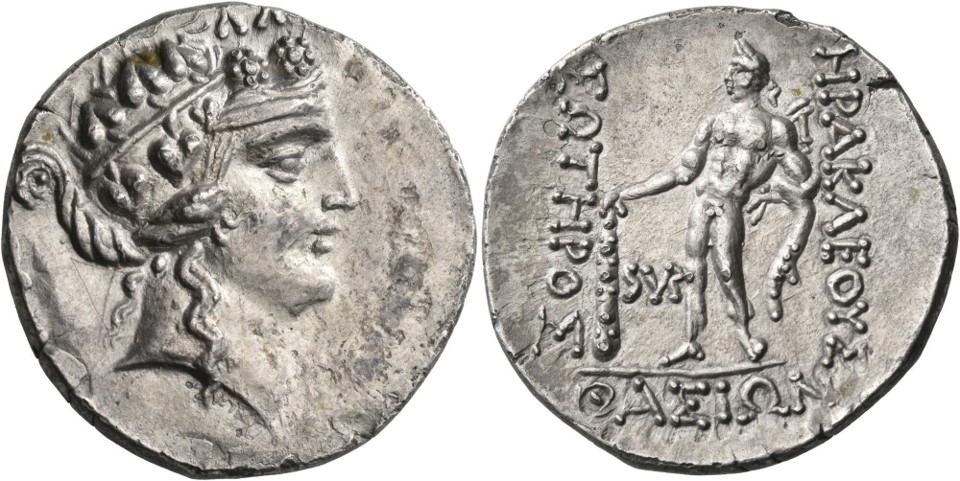
Head of youthful Dionysos to right, wearing ivy wreath
ReverseInscription or printing placed on the reverse.:
ΗΡΑΚΛΕΟΥΣ / ΣΩΤΗΡΟΣ / ΘAΣIΩN (Greek) Herakles standing left, nude but for lion's skin over his shoulder and left arm, resting right hand on club, in the inner left field, monogram of SVR (the VR in ligature)
Mint and issuing power
MintIdentifies the place of manufacture or issue of a numismatic object.:
AuthorityIdentifies the issuing power. The authority can be "pretended" when the name or the portrait of X is on the coin but he/she was not the issuing power. It can also be "uncertain" when there is no mention of X on the coin but he/she was the issuing power according to the historical sources:
FromIdentifies the initial date in a range assigned in a numismatic context. 80 BCE toIdentifies the final date in a range assigned in a numismatic context.. 60 BCE
Hellenistic 323-30 BCperiodTime period of the numismatic object.
Physical description
MetalThe physical material (usually metal) from which an object is made.: Silver
WeightWeight of the numismatic object (in grams).in grams: 15.7515.75 g <br />15,750 mg <br />
DenominationTerm indicating the value of a numismatic object. Examples: tetradrachm, chalkous, denarius.: tetradrachm
AxisDescribes the directional relationship between the obverse and reverse of a numismatic object.: 1111 mm <br />1.1 cm <br />
DiameterDescribes diameter of an object (in mm).: 31.531.5 mm <br />3.15 cm <br />
FromIdentifies the initial date in a range assigned in a numismatic context. 85 BCE toIdentifies the final date in a range assigned in a numismatic context.. 60 BCE
Hellenistic 323-30 BCperiodTime period of the numismatic object.
Physical description
DenominationTerm indicating the value of a numismatic object. Examples: tetradrachm, chalkous, denarius.ᵖ:
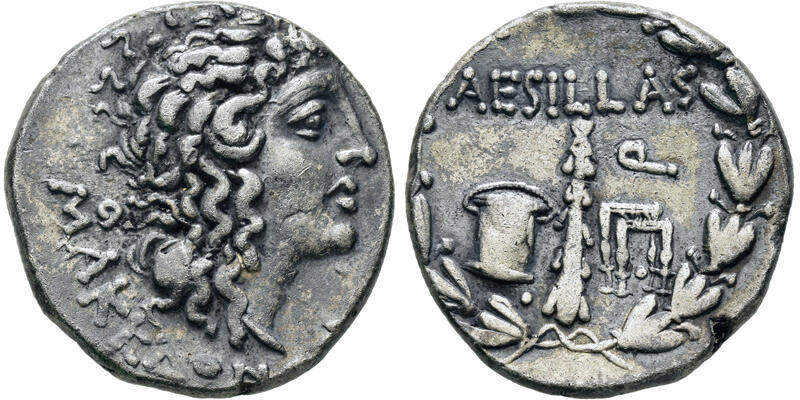
"overstruck, possibly on an Athenian New Style tetradrachm, but more likely on an earlier issue of Thasos" (wrong: on Aesillas of the second group as indicated by the typical shape of the oliver wreath)
References
^Prokopov, Ilya (2006), Die Silberprägung der Insel Thasos und die Tetradrachmen des "thasischen Typs" vom 2.-1. Jahrhundert v. Chr., Griechisches Münzwerk, Berlin, 342 p., 118 p. of plates
^Hoover, Oliver D. (2010), The Handbook of Greek Coinage Series, volume 6 : handbook of coins of the islands: Adriatic, Iionian, Thracian, Aegean, and Carpathian seas (excluding Crete and Cyprus), sixth to first centuries BC, Lancaster, 358 p.
^Callataÿ, François de (1996), "Les monnaies au nom d'Aesillas", in T. Hackens (ed.), Italiam Fato Profugi Hesperinaque Venerunt Litora. Numismatic Studies Dedicated to Vladimir and Elvira Eliza Clain-Stefanelli, Numismatica Lovaniensia 12, Louvain-la-Neuve, p. 113-151.
^Bauslaugh, Robert A. (2000), Silver coinage with the types of Aesillas the Quaestor, Numismatic Studies 22, New York.


 periodTime period of the numismatic object.