AuthorityIdentifies the issuing power. The authority can be "pretended" when the name or the portrait of X is on the coin but he/she was not the issuing power. It can also be "uncertain" when there is no mention of X on the coin but he/she was the issuing power according to the historical sources:
FromIdentifies the initial date in a range assigned in a numismatic context. 331 BCE toIdentifies the final date in a range assigned in a numismatic context.. 315 BCE
Hellenistic 323-30 BCperiodTime period of the numismatic object.
Physical description
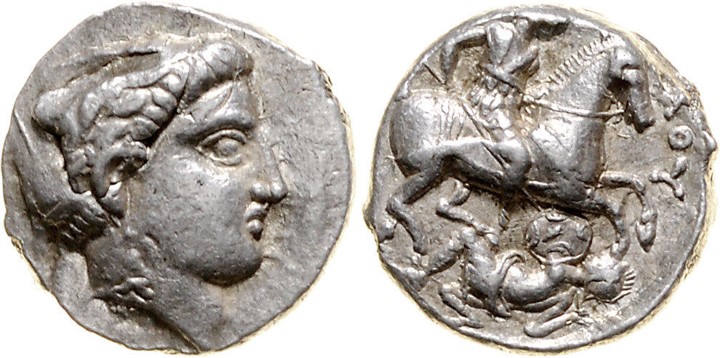
MetalThe physical material (usually metal) from which an object is made.: Silver
WeightWeight of the numismatic object (in grams).in grams: 13.4613.46 g <br />13,460 mg <br />
DenominationTerm indicating the value of a numismatic object. Examples: tetradrachm, chalkous, denarius.: tetradrachm
AxisDescribes the directional relationship between the obverse and reverse of a numismatic object.: 11 mm <br />0.1 cm <br />
^Sear, David R. (1978), Greek coins and their values. Vol. I, Europe, London, xl, 316 p.
^Hoover, Oliver D. (2017), Handbook of Coins of Macedon and Its Neighbors. 3. Part 2: Thrace, Skythia, and Taurike, Sixth to First Centuries BC, Lancaster-London, xix, 232 p.

 periodTime period of the numismatic object.