ObverseInscription or printing placed on the obverse.:
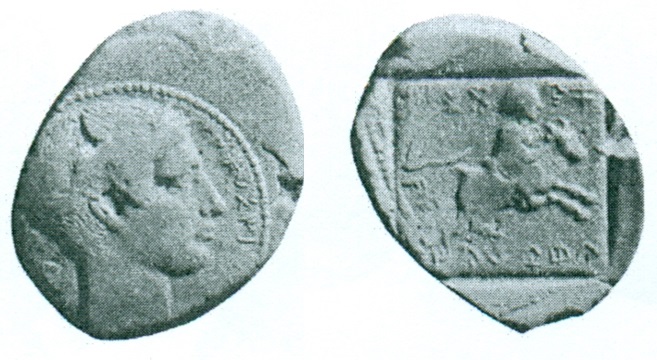
"pa-si-le-wo-se-ti-mo-ka-ri-wo-se" (Cypriot syllabic) (Cypriot) Head of Apollo right, wearing laurel wreath. Border of dots.
ReverseInscription or printing placed on the reverse.:
"pa-si-le-wo-se / ti-mo-ka-ri-wo-se" (Cypriot syllabic) (Cypriot) Aphrodite seated on bull right, wearing chiton, holding one horn. All within incuse square.
Mint and issuing power
MintIdentifies the place of manufacture or issue of a numismatic object.:
AuthorityIdentifies the issuing power. The authority can be "pretended" when the name or the portrait of X is on the coin but he/she was not the issuing power. It can also be "uncertain" when there is no mention of X on the coin but he/she was the issuing power according to the historical sources:
FromIdentifies the initial date in a range assigned in a numismatic context. 450 BCE toIdentifies the final date in a range assigned in a numismatic context.. 400 BCE
Classical 480-323 BCperiodTime period of the numismatic object.
Physical description
MetalThe physical material (usually metal) from which an object is made.: Silver
WeightWeight of the numismatic object (in grams).in grams: 10.8310.83 g <br />10,830 mg <br />
DenominationTerm indicating the value of a numismatic object. Examples: tetradrachm, chalkous, denarius.: double siglos
FromIdentifies the initial date in a range assigned in a numismatic context. 420 BCE toIdentifies the final date in a range assigned in a numismatic context.. 400 BCE
Classical 480-323 BCperiodTime period of the numismatic object.
Physical description
DenominationTerm indicating the value of a numismatic object. Examples: tetradrachm, chalkous, denarius.ᵖ:
^Hill, George Francis (1904), A Catalogue of the Greek coins in the British Museum, vol XX : Cyprus, London, cxliv, 119 p., xxvi pl.,
^Tziambazis, Elias (2002), A catalogue of the coins of Cyprus: from 560 B.C. to 1571 A.D., Larnaca, 89 p.
^Destrooper-Georgiades, A. (2013), "Monnaies chypriotes surfrappées des cités-royaumes," in Demetrios Michaelides (ed.), Epigraphy, numismatics, prosopography and History of Ancient Cyprus. Papers in honour of Ino Nicolaou, Studies in Mediterranean Archaeology and Literature PB 179, Uppsala, p. 9-40.


 periodTime period of the numismatic object.