ObverseInscription or printing placed on the obverse.:
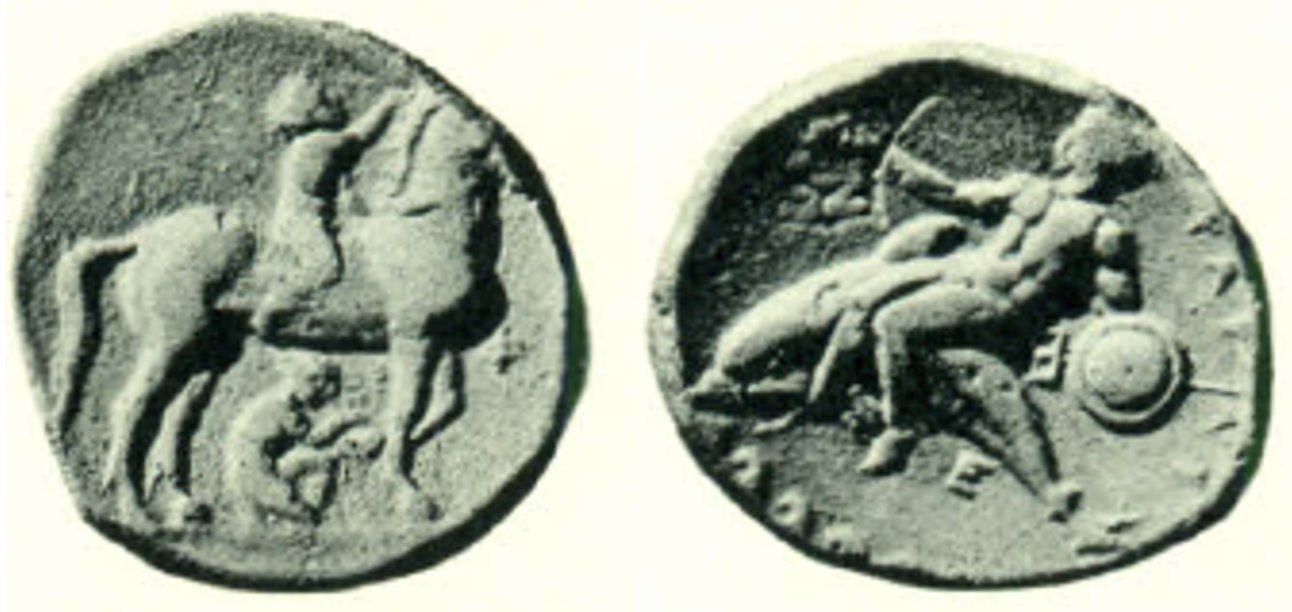
Youth seated on a horse right, crowning horse raisong foot for crouching youth to remove stone. In right field, φ.
ReverseInscription or printing placed on the reverse.:
TAPAΣ (Greek) Male character (Taras or Phalanthos), nude, seated on a dolphin to left, holding cantharos, trident and shield. Below, E and wave pattern.
Mint and issuing power
MintIdentifies the place of manufacture or issue of a numismatic object.:
AuthorityIdentifies the issuing power. The authority can be "pretended" when the name or the portrait of X is on the coin but he/she was not the issuing power. It can also be "uncertain" when there is no mention of X on the coin but he/she was the issuing power according to the historical sources:
Chronology
FromIdentifies the initial date in a range assigned in a numismatic context. 343 BCE toIdentifies the final date in a range assigned in a numismatic context.. 340BCE
Classical 480-323 BCperiodTime period of the numismatic object.
Physical description
MetalThe physical material (usually metal) from which an object is made.: Silver
DenominationTerm indicating the value of a numismatic object. Examples: tetradrachm, chalkous, denarius.: nomos
AuthorityIdentifies the authority in whose name (explicitly or implicitly) a numismatic object was issued.ᵖ:
Chronology
FromIdentifies the initial date in a range assigned in a numismatic context. 400 BCE toIdentifies the final date in a range assigned in a numismatic context.. 340 BCE
Classical 480-323 BCperiodTime period of the numismatic object.
Physical description
DenominationTerm indicating the value of a numismatic object. Examples: tetradrachm, chalkous, denarius.ᵖ:


 periodTime period of the numismatic object.