AuthorityIdentifies the issuing power. The authority can be "pretended" when the name or the portrait of X is on the coin but he/she was not the issuing power. It can also be "uncertain" when there is no mention of X on the coin but he/she was the issuing power according to the historical sources:
Chronology
FromIdentifies the initial date in a range assigned in a numismatic context. 470 BCE toIdentifies the final date in a range assigned in a numismatic context.. 460 BCE
Classical 480-323 BCperiodTime period of the numismatic object.
Physical description
MetalThe physical material (usually metal) from which an object is made.: Silver
WeightWeight of the numismatic object (in grams).in grams: 2.52.5 g <br />2,500 mg <br />
DenominationTerm indicating the value of a numismatic object. Examples: tetradrachm, chalkous, denarius.: hemidrachm
AxisDescribes the directional relationship between the obverse and reverse of a numismatic object.: 1111 mm <br />1.1 cm <br />
FromIdentifies the initial date in a range assigned in a numismatic context. 477 BCE toIdentifies the final date in a range assigned in a numismatic context.. 468 BCE
Classical 480-323 BCperiodTime period of the numismatic object.
Physical description
DenominationTerm indicating the value of a numismatic object. Examples: tetradrachm, chalkous, denarius.ᵖ:
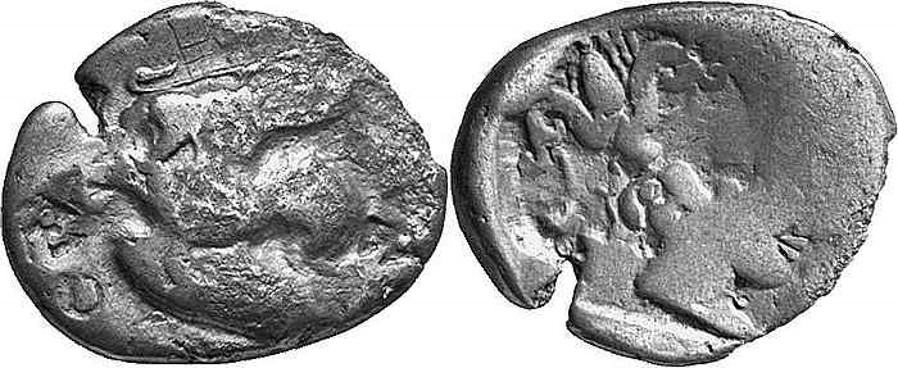
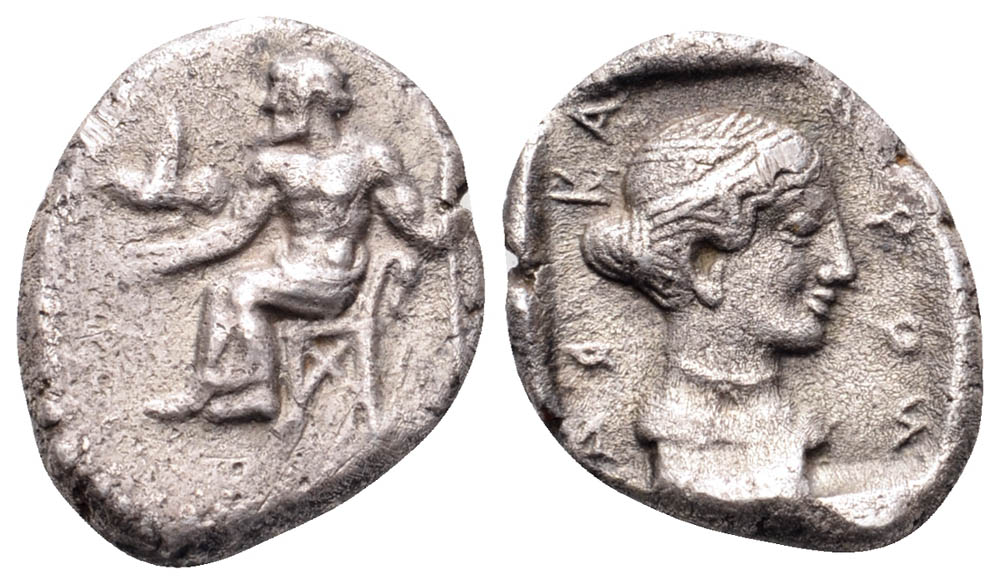
This is a coin of considerable numismatic importance! The Elean hemidrachm was struck soon after the coinage of Olympia began, but utilized a slightly earlier issue of the Arcadian League as a flan. While a number of Elean coins are known overstruck on issues from other mints, especially Aegina but sometimes from Boeotia, most of the undertypes are rarely closely datable. This piece is almost certainly R.T. Williams, The Confederate Coinage of the Arcadians in the Fifth Century B.C. ANSNNM 155 (1965), 86, ascribed to the mint of Tegea and struck c. 477-468. The goose-necked back of Zeus’ throne is visible above the eagle’s upper wing on the obverse, and the diagnostic lower profile of the head of the Arcadian goddess (Williams die R. 53) is visible below the thunderbolt on the reverse
References
abHoover, Oliver D. (2011), Handbook of Greek Coins 5. Coins of the Peloponnesos, Achaia, Phleiasia, Sikyonia, Elis, Triphylia, Messenia, Lakonia, Argolis, and Arkadia, Sixth to First Centuries BC, Lancaster (PA), 2011.
^Williams, Roderick T. (1965), The Confederate Coinage of the Arcadians in the Fifth Century B.C. ANSNNM 155, New York, xix, 141, xiv p.


 periodTime period of the numismatic object.