AuthorityIdentifies the issuing power. The authority can be "pretended" when the name or the portrait of X is on the coin but he/she was not the issuing power. It can also be "uncertain" when there is no mention of X on the coin but he/she was the issuing power according to the historical sources:
Chronology
FromIdentifies the initial date in a range assigned in a numismatic context. 345 BCE toIdentifies the final date in a range assigned in a numismatic context.. 340 BCE
Classical 480-323 BCperiodTime period of the numismatic object.
Physical description
MetalThe physical material (usually metal) from which an object is made.: Silver
WeightWeight of the numismatic object (in grams).in grams: 7.997.99 g <br />7,990 mg <br />
DenominationTerm indicating the value of a numismatic object. Examples: tetradrachm, chalkous, denarius.: nomos
AxisDescribes the directional relationship between the obverse and reverse of a numismatic object.: 99 mm <br />0.9 cm <br />
DiameterDescribes diameter of an object (in mm).: 2121 mm <br />2.1 cm <br />
^Ravel, Oscar E. (1990), Descriptive catalogue of the collection of Tarentine coins formed by M. P. Vlasto, London, Spink
^Troxell, Hyla S. (1972), Sylloge Nummorum Graecorum: The collection of the American Numismatic Society. Part 2. Lucania, New York
^Fischer-Bossert, Wolfgang (1999), Chronologie der Didrachmenprägung von Tarent, 510-280 v. Chr., Berlin, De Gruyter, xvii, 495 p., [84] pl.
^Hoover, Oliver D. (2018), The Handbook of Greek Coinage Series, Volume 1. Handbook of Coins of Italy and Magna Graecia, Sixth to First Centuries BC., Lancaster-London, 2018, lxi, 527 pages, 23 cm
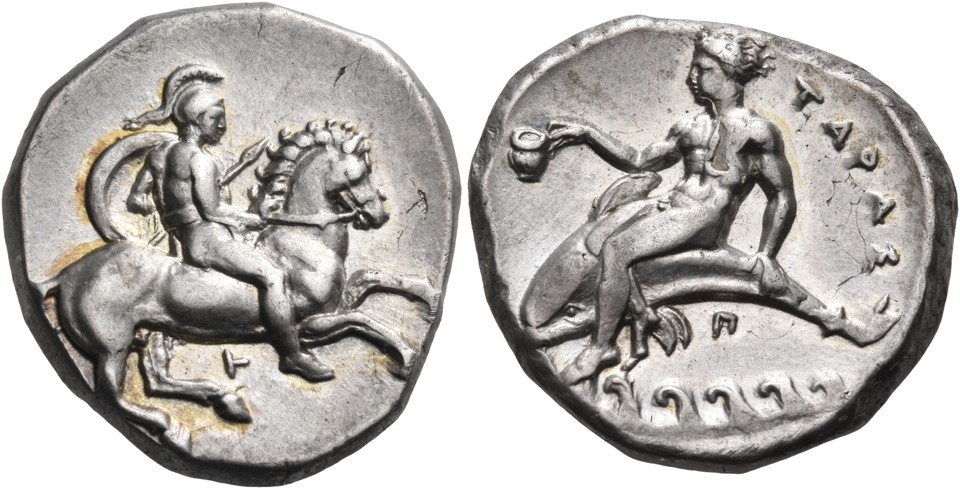

 periodTime period of the numismatic object.