AuthorityIdentifies the issuing power. The authority can be "pretended" when the name or the portrait of X is on the coin but he/she was not the issuing power. It can also be "uncertain" when there is no mention of X on the coin but he/she was the issuing power according to the historical sources:
Chronology
FromIdentifies the initial date in a range assigned in a numismatic context. 344 BCE toIdentifies the final date in a range assigned in a numismatic context.. 336 BCE
Classical 480-323 BCperiodTime period of the numismatic object.
Physical description
MetalThe physical material (usually metal) from which an object is made.: Bronze
WeightWeight of the numismatic object (in grams).in grams: 16.6616.66 g <br />16,660 mg <br />
DenominationTerm indicating the value of a numismatic object. Examples: tetradrachm, chalkous, denarius.: dilitron
ObverseInscription or printing placed on the obverse.:
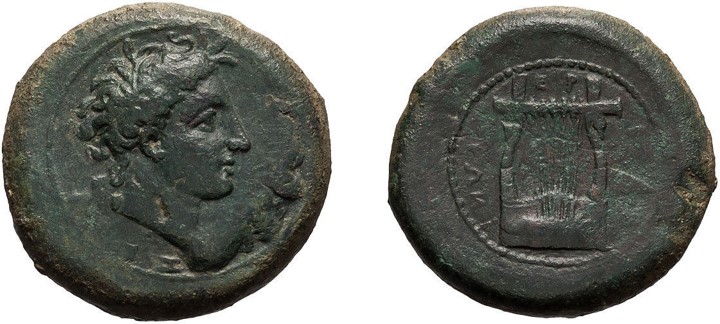
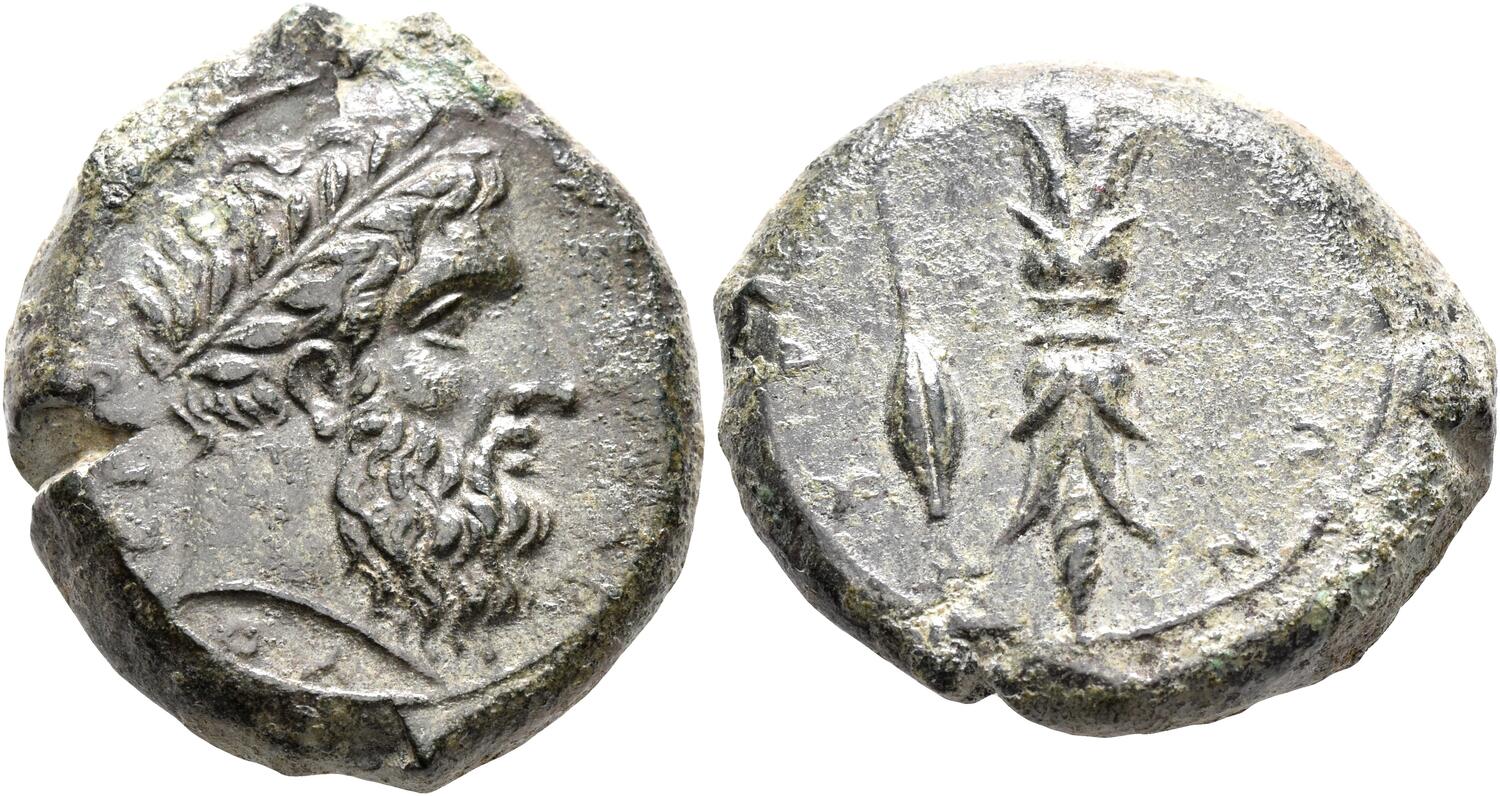
ΖΕΥΣ ΕΛΕΥΘΕΡΙΟΣ (Greek) Head of Zeus Eleutherios right, wearing laurel wreath (visible on obverse: brow of Zeus starting at truncation of neck of Sicily).
ReverseInscription or printing placed on the reverse.:
ΣΥΡΑΚΟΣΙΩΝ (Greek) Thunderbolt (visible on reverse).
Mint and issuing power
MintIdentifies the place of manufacture or issue of a numismatic object.ᵖ:
FromIdentifies the initial date in a range assigned in a numismatic context. 343 BCE toIdentifies the final date in a range assigned in a numismatic context.. 317 BCE
Classical 480-323 BCperiodTime period of the numismatic object.
Physical description
DenominationTerm indicating the value of a numismatic object. Examples: tetradrachm, chalkous, denarius.ᵖ:
"overstruck on hemilitron of Syracuse, the head of Zeus is visible with brow of Zeus starting at truncation of neck of Sikelia"; "Our coin is struck over a Hemilitron of Syracuse (BMC Sicily 313-318), the head of Zeus right is slightly visible. The inscription below the truncation starts ΙEYΣ [...]".
References
abSylloge Nummorum Graecorum ANS 4. The Collection of the American Numismatic Society. Sicily 2 (Galaria - Styella), New York, 1977, 25 pl.
^Calciati, Romolo (1987), Corpus nummorum siculorum. La monetazione di bronzo/The bronze coinage, vol. 3, Milan, Edizioni G. M.
abHoover, Oliver D. (2012), The Handbook of Greek Coinage Series. 2. Handbook of the Coins of Sicily (Including Lipara). Civic, Royal, Siculo-Punic, and Romano-Sicilian Issues. Sixth to First Centuries BC, Lancaster-London, 489 p.
abPuglisi, Mariangela (2009), La Sicilia da Dionisio I a Sesto Pompeo : circolazione e funzione della moneta, Messina, DiScAM, p. 519.
^Calciati, Romolo (1986), Corpus nummorum siculorum. La monetazione di bronzo/The bronze coinage, vol. 2, Milan, Edizioni G. M.
.jpg)
_overstruck_variety.jpg)
 periodTime period of the numismatic object.