ObverseInscription or printing placed on the obverse.:
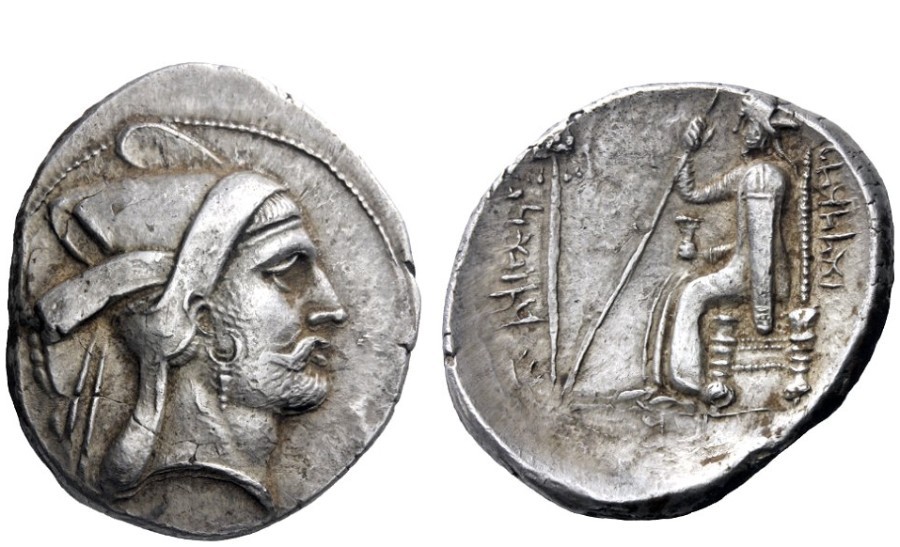
Head of Baydad right, wearing earring, satrapal cap (kyrbasia) and diadem. Border of dots.
ReverseInscription or printing placed on the reverse.:
bgdt prtrk' zy lhy bgwrt (="Baydad, son of Bagawart, dynast of the Gods") (Aramaic) Baydād enthroned left, wearing long cloak and kyrbasia, holding sceptre and cup. To left, standard.
Mint and issuing power
MintIdentifies the place of manufacture or issue of a numismatic object.:
AuthorityIdentifies the issuing power. The authority can be "pretended" when the name or the portrait of X is on the coin but he/she was not the issuing power. It can also be "uncertain" when there is no mention of X on the coin but he/she was the issuing power according to the historical sources:
FromIdentifies the initial date in a range assigned in a numismatic context. 299 BCE toIdentifies the final date in a range assigned in a numismatic context.. 250 BCE
Hellenistic 323-30 BCperiodTime period of the numismatic object.
Physical description
MetalThe physical material (usually metal) from which an object is made.: Silver
WeightWeight of the numismatic object (in grams).in grams: 16.9216.92 g <br />16,920 mg <br />
DenominationTerm indicating the value of a numismatic object. Examples: tetradrachm, chalkous, denarius.: tetradrachm

 periodTime period of the numismatic object.