ObverseInscription or printing placed on the obverse.:
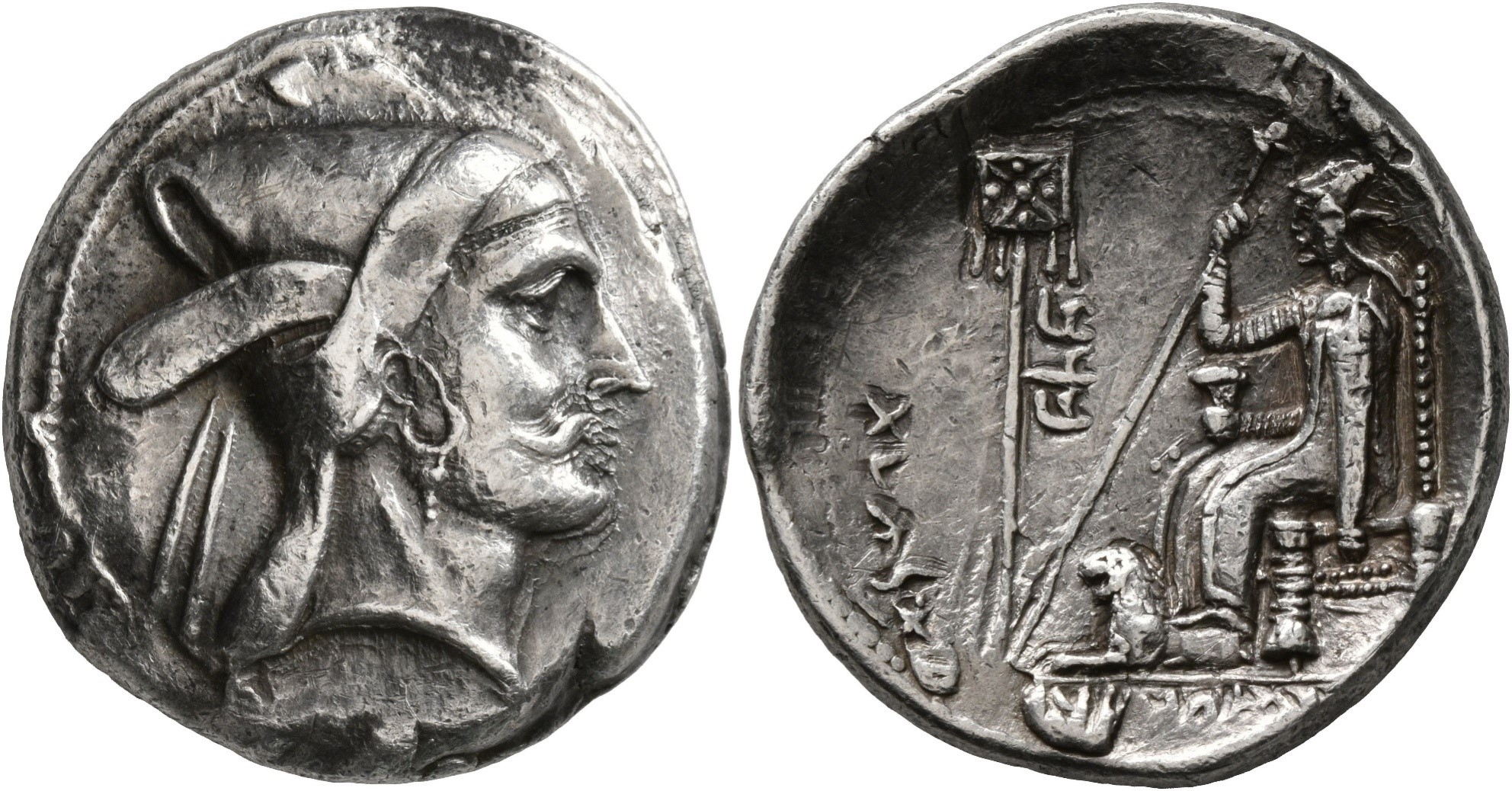
Head of Bagadat right, wearing earring, satrapal cap (kyrbasia) and diadem. Border of dots.
ReverseInscription or printing placed on the reverse.:
𐡁𐡓𐡁 / 𐡀𐡍𐡄𐡏𐡀 "Baydad, son of Bagawart, dynast of the Gods" (Aramaic) (Aramaic) Baydād enthroned left, placing his feet on a lion recumbent left, wearing long cloak and kyrbasia, holding sceptre and cup. To left, standard.
Mint and issuing power
MintIdentifies the place of manufacture or issue of a numismatic object.:
AuthorityIdentifies the issuing power. The authority can be "pretended" when the name or the portrait of X is on the coin but he/she was not the issuing power. It can also be "uncertain" when there is no mention of X on the coin but he/she was the issuing power according to the historical sources:
FromIdentifies the initial date in a range assigned in a numismatic context. 299 BCE toIdentifies the final date in a range assigned in a numismatic context.. 250 BCE
Hellenistic 323-30 BCperiodTime period of the numismatic object.
Physical description
MetalThe physical material (usually metal) from which an object is made.: Silver
WeightWeight of the numismatic object (in grams).in grams: 16.9616.96 g <br />16,960 mg <br />
DenominationTerm indicating the value of a numismatic object. Examples: tetradrachm, chalkous, denarius.: tetradrachm
AxisDescribes the directional relationship between the obverse and reverse of a numismatic object.: 1111 mm <br />1.1 cm <br />
DiameterDescribes diameter of an object (in mm).: 2929 mm <br />2.9 cm <br />
^Alram, Michael (1986), Iranisches Personennamenbuch. Band IV: Nomina Propria Iranica In Nummis, Vienna.
^Klose, Dietrich O. A. - Müseler, Wilhelm (2008), Statthalter Rebellen Könige - Die Münzen aus Persepolis von Alexander dem Großen zu den Sasaniden, Munich, xii, 90 p.
^Nelson, Bradley R. (2011), Numismatic Art of Persia: The Sunrise Collection Part I: Ancient- 650 BC to AD 650, Lancaster
^van't Haaff, Peter A. (2012), "Catalogue of Persis Coinage, Ca. 280 B.C. – A.D. 228 : 34 Kings of 5 dynasties that ruled in Iran for 500 years,” Ancient Civilizations from Scythia to Siberia, 18, 2012, p. 207-272.

 periodTime period of the numismatic object.