ObverseInscription or printing placed on the obverse.:
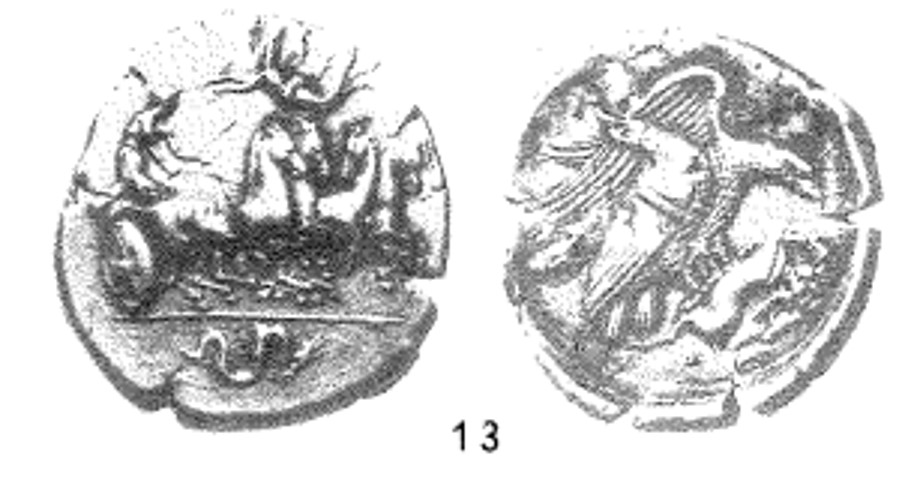
Nymph, with her robes billowing behind her, driving quadriga galloping to right, about to turn, above, Nike flying left to crown the charioteer, in the exergue, ketos to right
ReverseInscription or printing placed on the reverse.:
ΑΚΡΑΓ-ΑΝΤOΣ (retrograde) (Greek) Two eagles standing right on a dead hare lying on a rock, the closer eagle has closed wings and his head raised in triumph, while the further has open wings and his head bent down to tear at the hare
Mint and issuing power
MintIdentifies the place of manufacture or issue of a numismatic object.:
AuthorityIdentifies the issuing power. The authority can be "pretended" when the name or the portrait of X is on the coin but he/she was not the issuing power. It can also be "uncertain" when there is no mention of X on the coin but he/she was the issuing power according to the historical sources:
Chronology
FromIdentifies the initial date in a range assigned in a numismatic context. 409 BCE toIdentifies the final date in a range assigned in a numismatic context.. 406 BCE
Classical 480-323 BCperiodTime period of the numismatic object.
Physical description
MetalThe physical material (usually metal) from which an object is made.: Silver
WeightWeight of the numismatic object (in grams).in grams: 17.3017.3 g <br />17,300 mg <br />
DenominationTerm indicating the value of a numismatic object. Examples: tetradrachm, chalkous, denarius.: tetradrachm
FromIdentifies the initial date in a range assigned in a numismatic context. 407 BCE toIdentifies the final date in a range assigned in a numismatic context.. 398 BCE
Classical 480-323 BCperiodTime period of the numismatic object.
Physical description
DenominationTerm indicating the value of a numismatic object. Examples: tetradrachm, chalkous, denarius.ᵖ:


 periodTime period of the numismatic object.