AuthorityIdentifies the issuing power. The authority can be "pretended" when the name or the portrait of X is on the coin but he/she was not the issuing power. It can also be "uncertain" when there is no mention of X on the coin but he/she was the issuing power according to the historical sources:
FromIdentifies the initial date in a range assigned in a numismatic context. 280 BCE toIdentifies the final date in a range assigned in a numismatic context.. 72 BCE
Hellenistic 323-30 BCperiodTime period of the numismatic object.
Physical description
MetalThe physical material (usually metal) from which an object is made.: Bronze
WeightWeight of the numismatic object (in grams).in grams: 2.12.1 g <br />2,100 mg <br />
DiameterDescribes diameter of an object (in mm).: 15.615.6 mm <br />1.56 cm <br />
FromIdentifies the initial date in a range assigned in a numismatic context. 283 BCE toIdentifies the final date in a range assigned in a numismatic context.. 222 BCE
Hellenistic 323-30 BCperiodTime period of the numismatic object.
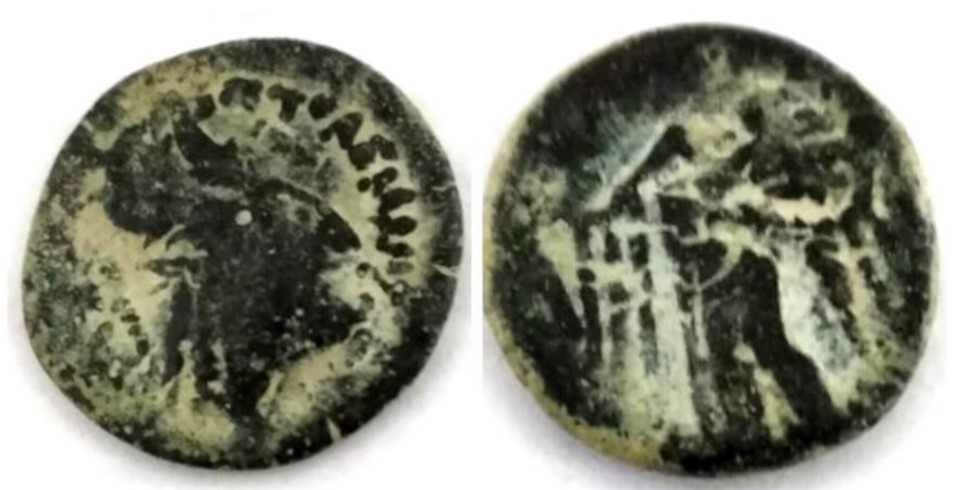
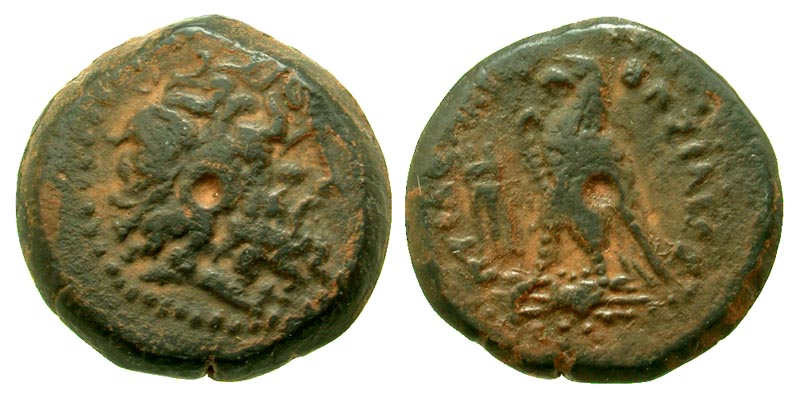
"Overstruck on a Ptolemaic bronze issue, likely Ptolemy II or III, with much of the undertype visible."
References
^Meshorer, Ya'akov (1975), Nabatean Coins, Qedem, Monographs of the Institute of Archaeology 3, Jerusalem, 111 p., 8 pl.
^Schmitt-Korte, Karl - Price, Martin J. (1994), "Nabataean coinage. Part 3, The Nabataean monetary system", Numismatic Chronicle, 154, p. 67-131, pl. 10-12.
^Hoover, Oliver D. (2010), The Handbook of Greek Coinage Series. 10. handbook of coins of the Southern Levant : Phoenicia, southern Koile Syria (including Judaea), and Arabia, Lancaster-London, lxxix, 201 p.
^Svoronos, Ioannes N. (1904-1908), Τὰ νομίσματα τοῦ κράτους τῶν Πτολεμαίων (Ta nomismata tou kratous tōn Ptolemaiōn - The coins of the Ptolemaic rulers), Athens, 4 v., 68 pl.
^Lorber, Catharine C. (2018), Coins of the Ptolemaic empire : Part I. Ptolemy I through Ptolemy IV, 2 vol., New York.

.jpg)
 periodTime period of the numismatic object.